

Introduction: Is There Something Better Than Outsourcing?
For years, outsourcing has been the go-to strategy for startups and mid-size companies seeking cost efficiency and access to global talent. It offers quick scalability and reduced operational overhead. However, as businesses mature and digital transformation accelerates, many leaders begin to ask a critical question:
“Is there a better alternative to outsourcing that provides more control, innovation, and long-term value?”
The answer increasingly points to the Managed Global Capability Center (Managed GCC) model. This approach combines the strategic advantages of owning a dedicated offshore team with the operational ease of outsourcing, making it an ideal evolution for growing organizations.
This article explores why companies are shifting from outsourcing to Managed GCCs in India, when the transition makes sense, and how to determine the right model for your business.
What Is a Managed GCC?
A Managed Global Capability Center (GCC) is a dedicated offshore team that operates as an extension of your organization while being set up and managed by an experienced local partner. Unlike traditional outsourcing, where services are delivered on a vendor-client basis, a Managed GCC provides:
- Dedicated teams aligned with your business goals
- Full control over intellectual property (IP)
- Integration with your company culture and processes
- Long-term scalability and innovation
- Operational support handled by a local partner
Key Components of a Managed GCC
- Dedicated Engineering or Operations Teams
- Legal and Compliance Framework
- Infrastructure and IT Setup
- HR, Recruitment, and Retention Management
- Governance and Performance Management
- Scalable Engagement Models
Outsourcing vs. Managed GCC: A Quick Comparison
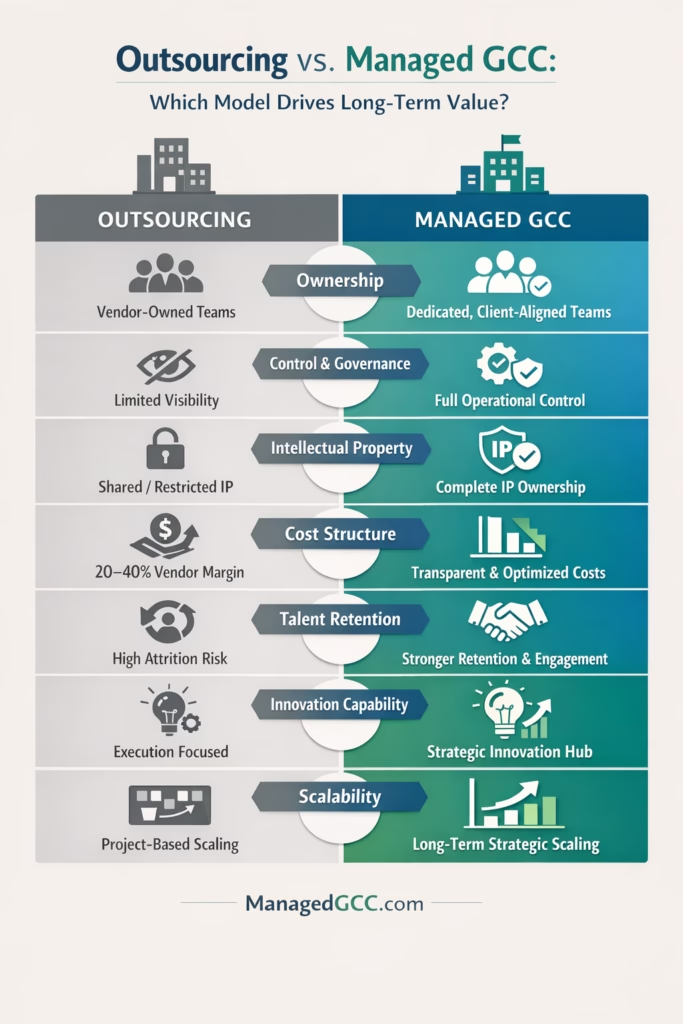
| Aspect | Traditional Outsourcing | Managed GCC |
|---|---|---|
| Ownership of Team | Vendor-owned | Client-aligned and dedicated |
| Control Over IP | Limited | Full control |
| Cultural Alignment | Moderate | High |
| Scalability | Project-based | Long-term and strategic |
| Innovation Capability | Limited | High |
| Cost Efficiency (Long Term) | Moderate | High |
| Employee Retention | Vendor-dependent | Higher with dedicated engagement |
| Brand Presence in India | None | Strong employer brand |
Why India Is the Preferred Destination for Managed GCCs
India has emerged as the global hub for Global Capability Centers due to its strong ecosystem:
1. Vast Talent Pool
- Over 5 million technology professionals
- Strong expertise in AI, cloud, cybersecurity, and digital engineering
2. Cost Advantage
- Up to 60–70% cost savings compared to Western markets.
- Better ROI over the long term compared to outsourcing.
3. Mature GCC Ecosystem
- 1,700+ GCCs operating across India.
- Presence of global enterprises validates the model for startups and mid-size firms.
4. Favorable Business Environment
- Supportive government policies and improved ease of doing business.
- Strong legal frameworks for IP protection and compliance.
5. Time Zone and English Proficiency
- Enables seamless collaboration with global teams.
- High level of communication efficiency.
Why Companies Are Moving from Outsourcing to Managed GCCs
1. Greater Control and Transparency
Outsourcing often limits visibility into team performance and decision-making. Managed GCCs provide direct oversight, enabling companies to align teams with strategic objectives.
2. Ownership of Intellectual Property
With outsourcing, IP ownership can sometimes be ambiguous. A Managed GCC ensures that all innovations and developments remain fully owned by the client.
3. Long-Term Cost Efficiency
While outsourcing may appear cost-effective initially, hidden costs such as vendor margins, transition overheads, and frequent resource changes can accumulate. Managed GCCs eliminate these inefficiencies over time.
4. Improved Talent Retention
Dedicated teams foster stronger engagement and career growth, leading to lower attrition rates and better knowledge retention.
5. Enhanced Innovation and Strategic Capability
Managed GCCs evolve from execution centers into innovation hubs, supporting R&D, product engineering, and digital transformation initiatives.
6. Stronger Cultural Alignment
Teams within a Managed GCC operate as an extension of the parent organization, adopting its values, processes, and long-term vision.
Signs It’s Time to Move from Outsourcing to a Managed GCC
Consider transitioning to a Managed GCC if your organization experiences the following:
✅ You Have Long-Term Product Roadmaps
If your development needs are continuous rather than project-based, a dedicated team ensures stability and knowledge retention.
✅ You Need Greater Control Over Delivery
Organizations seeking strategic alignment and governance benefit from the Managed GCC model.
✅ Intellectual Property Is Critical
Companies building proprietary platforms or products require stronger IP protection.
✅ Outsourcing Costs Are Increasing
Vendor margins and repeated onboarding costs can make outsourcing less economical over time.
✅ You Want to Build an Employer Brand in India
Establishing a GCC strengthens your presence in one of the world’s largest talent markets.
✅ You Require Faster Innovation
Dedicated teams enable experimentation and innovation beyond transactional delivery.
When Outsourcing Still Makes Sense
While Managed GCCs offer numerous advantages, outsourcing remains a viable option in certain scenarios:
- Short-term or project-based requirements
- Limited budget or early-stage startups
- Need for highly specialized or niche skills
- Uncertain product-market fit
- Rapid, temporary scaling needs
The key is aligning the engagement model with your business maturity and strategic objectives.
Managed GCC vs. Outsourcing: Cost Perspective
| Cost Component | Outsourcing | Managed GCC |
|---|---|---|
| Vendor Margin | 20–40% | Minimal |
| Recruitment Costs | Included but recurring | One-time and optimized |
| Attrition Impact | High | Lower |
| Knowledge Retention | Limited | Strong |
| Long-Term ROI | Moderate | High |
Example:
A 10-member engineering team in the United States may cost approximately $1.5 million annually, while a Managed GCC in India can deliver comparable capabilities at 40–60% lower costs, with greater strategic value.
How the Managed GCC Model Works
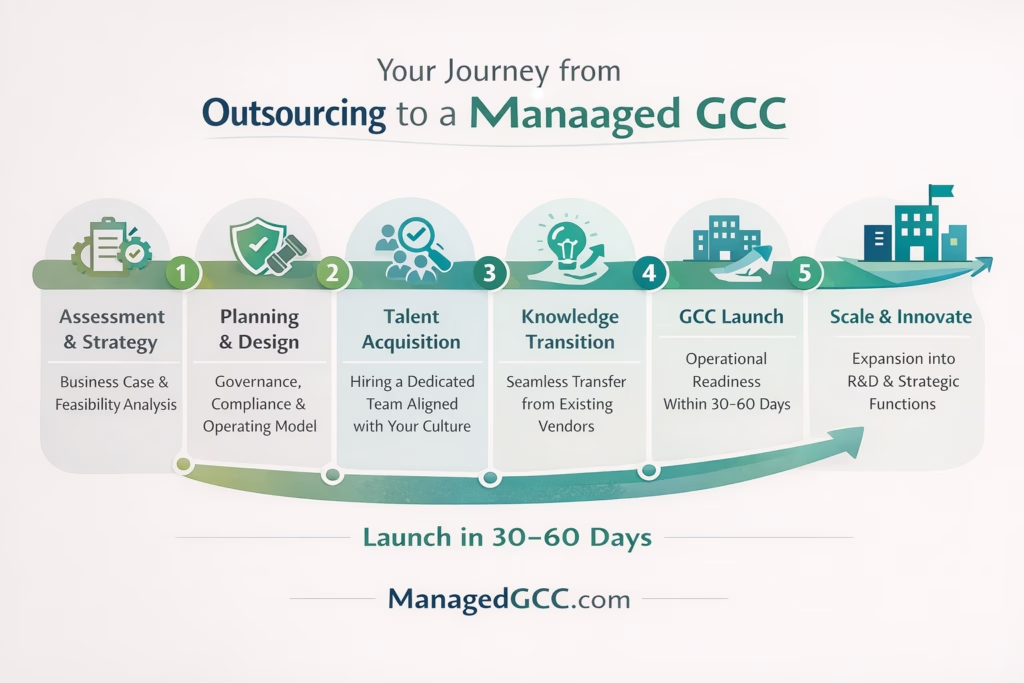
Step 1: Strategy and Feasibility
Assessment of business objectives, talent needs, and financial viability.
Step 2: Setup and Compliance
Legal entity support, infrastructure setup, and governance framework.
Step 3: Talent Acquisition
Recruitment of dedicated professionals aligned with the client’s culture.
Step 4: Transition and Integration
Knowledge transfer from existing outsourcing vendors and integration with internal teams.
Step 5: Ongoing Management and Optimization
Continuous performance management, HR support, and scalability.
Decision Framework: Is a Managed GCC Right for You?
| Business Stage | Recommended Model |
|---|---|
| Early-Stage Startup | Outsourcing |
| Growth-Stage Startup | Hybrid (Outsourcing + GCC) |
| Scaling Startup | Managed GCC |
| Mid-Size Enterprise | Managed GCC |
| Large Enterprise | Captive GCC |
Real-World Scenario
Scenario: A SaaS startup initially outsourced its product development to accelerate time-to-market. As the company scaled, it faced challenges related to rising costs, inconsistent quality, and limited innovation.
Solution: Transitioning to a Managed GCC in India enabled the company to:
- Reduce operational costs by 50%
- Improve release velocity by 30%
- Enhance employee retention and domain expertise
- Gain full control over product strategy and IP
Why Choose ManagedGCC.com?
ManagedGCC.com specializes in helping startups and mid-size companies establish and scale dedicated offshore teams in India with minimal risk and maximum efficiency.
Key Differentiators
- Rapid Setup: Launch your GCC in as little as 30 days
- End-to-End Management: From legal and compliance to HR and IT
- Scalable Engagement Models: Flexible growth aligned with business needs
- Strong Talent Network: Access to top-tier engineering and operational talent
- Governance and Transparency: Clear SLAs, KPIs, and reporting
- Risk Mitigation: Seamless transition from existing outsourcing vendors
Frequently Asked Questions (FAQs)
Is a GCC better than outsourcing for startups?
Yes, particularly for growth-stage startups with long-term product roadmaps. A Managed GCC provides greater control, IP ownership, and cost efficiency while maintaining operational flexibility.
How long does it take to set up a Managed GCC in India?
With an experienced partner, a Managed GCC can typically be established within 4 to 8 weeks, depending on team size and operational requirements.
What is the minimum team size for a Managed GCC?
Most organizations start with 5 to 10 professionals, scaling gradually as business needs evolve.
Do companies need to establish a legal entity in India?
Not necessarily. The Managed GCC model allows organizations to operate without setting up a local entity, as the partner manages compliance and administrative responsibilities.
Can we transition from our existing outsourcing vendor?
Yes. A structured transition plan ensures knowledge transfer and business continuity with minimal disruption.
Final Thoughts: The Future Beyond Outsourcing
Outsourcing has played a pivotal role in helping businesses scale efficiently. However, as organizations seek deeper strategic alignment, innovation, and long-term value, the Managed GCC model is emerging as the preferred alternative.
For startups and mid-size companies, transitioning to a Managed GCC in India represents not just a cost-saving initiative but a strategic investment in sustainable growth and innovation.
Ready to Explore the Next Step?
If you’re evaluating whether to move beyond outsourcing, ManagedGCC.com can help you assess feasibility and guide you through every stage of the journey.
👉 Contact us today to discover how a Managed GCC can accelerate your growth and provide a lasting competitive advantage.
About the author

Naresh D
IT Consultant | Software Architect | Full-Stack Developer
Passionate, lifelong learner with 10+ years of experience in software development, solution architecture, and IT consulting. Skilled in .NET, Azure, DevOps, and enterprise solutions.
💼 Expertise in IT staff augmentation, digital transformation, and managing offshore teams.
🚀 Hands-on with Agile, CI/CD, cloud technologies, and software architecture.
🤝 Always open to collaboration—connect for IT consulting, software development, or technical guidance.


